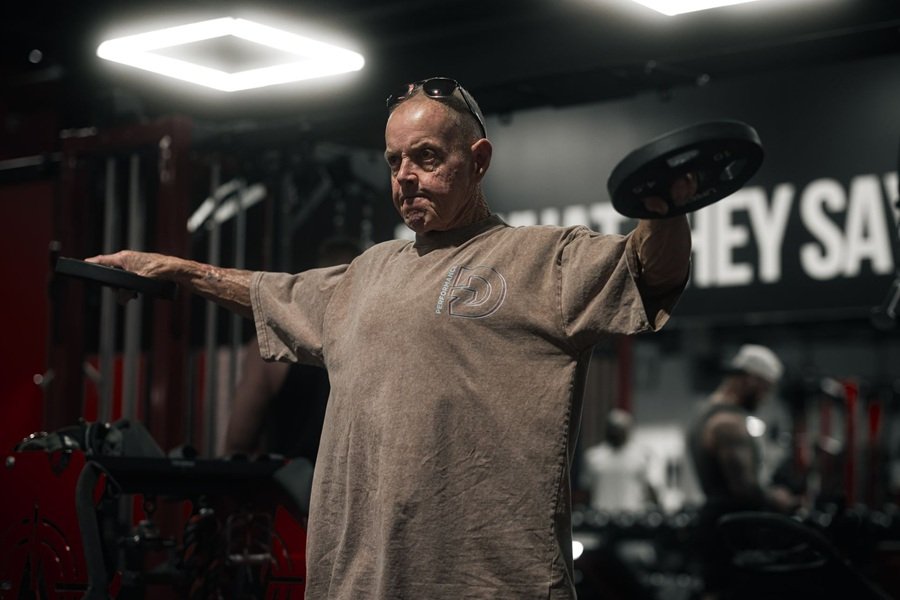
According to Bill Jones, you Can!
One of the questions I hear regularly from men and women over 50 is a very simple one:
“I’ve lost a lot of muscle over the years. Can you rebuild lost muscle after 50?”
My answer is almost always the same.
Yes – but you have to be prepared to train sensibly and give your body time to respond.
I have spent most of my life around bodybuilding, and I have seen people make remarkable changes to their physiques at ages when they assumed their best years were behind them. I’ve also seen people make the mistake of believing that because they are older, they should stop trying to build muscle altogether.
I don’t agree with that.
Age changes the way we should train, but it does not mean we should stop training.
In fact, if you are over 50 and have previously built a good amount of muscle, you may have something very valuable on your side: muscle memory.
What Is Muscle Memory?
Muscle memory is the term commonly used to describe the body’s ability to regain strength and muscle after a period away from resistance training.
Imagine someone who trained seriously in their 20s and 30s but then stopped for ten, fifteen or even twenty years. They may have lost a considerable amount of muscle and strength during that time.
When they eventually return to the gym, however, they often find that their progress is much faster than it was when they first started bodybuilding.
That isn’t simply wishful thinking.
Previous resistance training can leave long-lasting adaptations in skeletal muscle, and research into muscle memory has identified several mechanisms that may help explain why previously trained muscle can respond differently when training resumes.
I have seen this principle in practice many times.
You Are Not Starting From Zero
This is probably the most important message I can give someone returning to bodybuilding after 50.
You may feel as though you are starting from zero.
You are not.
Perhaps you used to bench press a respectable weight, had good shoulders and arms, or spent years developing strong legs and a broad back.
Then life got in the way.
Work became more demanding. Family commitments changed. Perhaps an injury forced you to stop. Maybe you simply lost interest in training for a while.
Eventually you look in the mirror and realise that much of the physique you worked so hard to develop has disappeared.
It is very easy to think:
“That’s it. I’m too old now.”
Don’t make that mistake.
Your current condition may be very different from the condition you were in twenty years ago, but your previous training experience has not necessarily been wasted.
Why Strength Can Return Surprisingly Quickly
One of the most encouraging things about returning to weight training is that strength can sometimes return before you expect it.
Part of this is because your nervous system has previously learned how to perform the movements efficiently.
Think about learning to ride a bicycle.
You might not have ridden for twenty years, but you don’t have to learn everything from the beginning.
Resistance training is obviously much more complicated than riding a bicycle, but the principle of previously learned movement patterns is useful when understanding why an experienced lifter can often regain lost performance more quickly than a complete beginner.
There is another important point.
Muscle memory does not mean you can rush the process.
That is where many people make a serious mistake.
Don’t Try to Train Like You Did at 30
This is something I would strongly advise anyone over 50 to remember.
If you trained hard when you were 25, you may remember throwing enormous weights around, training six days a week and recovering remarkably quickly.
You cannot assume that the same approach is appropriate now.
Your muscles may still be capable of considerable work, but your joints, tendons and connective tissues may not appreciate being thrown straight back into the deep end.
The sensible approach is to build back gradually.
Start with manageable weights.
Concentrate on technique.
Give your body time to adapt.
Then increase the workload progressively.
That is not taking the easy option.
It is training intelligently.
Can Men Over 50 Still Build New Muscle?
Absolutely.
There is sometimes a strange belief that muscle growth has an expiry date.
It doesn’t.
Older adults can respond positively to resistance training, and recent coverage of strength training for older people continues to emphasise that it is never too late to begin or return to resistance exercise.
The rate of progress may not be identical to that of a 20-year-old beginner, and recovery may require greater attention.
But those are reasons to adjust your training – not reasons to abandon it.
For someone over 50, gaining even a modest amount of muscle can make a noticeable difference to appearance, strength and everyday physical ability.
The Importance of Progressive Overload
One of the biggest mistakes I see is people returning to the gym and simply going through the motions.
If you want to rebuild muscle, your body needs a reason to adapt.
That is where progressive overload comes in.
This does not necessarily mean adding weight to the bar every single workout.
Progress can mean:
- Increasing the weight slightly
- Performing more repetitions
- Improving your technique
- Increasing your range of movement
- Completing another set
- Controlling the weight more effectively
The important thing is that your training gradually becomes more demanding.
You don’t need to destroy yourself.
You need to give your muscles a reason to improve.
Don’t Neglect Your Legs
If your main objective is to regain your old physique, it can be tempting to concentrate on the muscles you can see in the mirror.
That usually means chest, arms and shoulders.
Don’t make that mistake.
Strong legs are fundamental to a strong body.
Exercises such as leg presses, squats, hamstring curls and calf raises can form part of a well-designed lower-body programme, depending upon your experience and physical condition.
Training the legs also gives you something much more valuable than improved appearance.
It helps maintain the strength required for walking, climbing stairs, getting out of a chair and remaining physically independent.
Nutrition Becomes Important Too
You cannot build muscle from training alone.
Your body needs sufficient energy and protein to support muscle repair and adaptation.
This doesn’t mean that every over-50 bodybuilder needs to consume enormous quantities of food or live on chicken and rice.
It means paying attention to the quality and quantity of what you eat.
If you are trying to lose excess body fat while rebuilding muscle, your nutritional strategy may look different from someone deliberately trying to gain bodyweight.
The important thing is to have a plan that supports your objective.
What About People Who Have Never Bodybuilt?
This is perhaps even more encouraging.
If you are over 50 and have never trained seriously with weights, you haven’t missed your opportunity.
You are simply starting at a different point.
You don’t need to become a competitive bodybuilder.
You don’t need to lift enormous weights.
And you certainly don’t need to compare yourself with the biggest person in the gym.
Your objective should be to become stronger and more capable than you were previously.
That is a competition worth winning.
The Bill Jones Approach
After decades in bodybuilding, including winning the Mr Universe title, I have learned that there is no substitute for consistency.
You can have the finest equipment in the world.
You can have the perfect training programme.
You can buy all the supplements you like.
But if you don’t turn up and train consistently, none of it matters.
That is one of the reasons I am still passionate about Gym 21 Liverpool.
The gym has always been about more than competitive bodybuilding. Yes, we have produced champions, and I am proud of that history, but the majority of people who walk through the doors simply want to improve themselves.
Some want to lose weight.
Some want to build muscle.
Some want to regain the fitness they had years ago.
And some simply want to remain strong as they get older.
All of those are worthwhile goals.
Your Best Years May Not Be Behind You
If you are over 50 and looking at an old photograph of yourself wondering where that physique went, don’t automatically assume that you have lost it forever. Can you rebuild lost muscle after 50?
You may not reproduce exactly what you looked like at 25.
But that doesn’t mean you cannot make a dramatic improvement from where you are today.
Start sensibly.
Train consistently.
Eat appropriately.
Recover properly.
And give your body time to respond.
I’ve watched people surprise themselves in the gym many times.
The biggest obstacle is often not age.
It is the belief that age means you can no longer improve.
I don’t believe that.
And after a lifetime in bodybuilding, I have seen far too much evidence to believe otherwise.
The article ‘Can you rebuild lost muscle after 50’ was written and first published on behalf of Bill Jones Mr Universe on Monday 14th September 2026 at 18:30 and is subject to copyright – All Rights are Reserved.
If you liked this article, I’m sure that you will also like strength training for longevity and also muscle power for over 50s.
If you have a medical condition, take prescribed medication or are considering a significant change to your diet, speak to your GP or an appropriately qualified healthcare professional before making major changes. In particular, prescribed medication should never be stopped or altered without medical advice.
All the best guys!
Bill Jones Mr Universe